
Guide
Building a floating pontoon yourself: what do you need and what does it cost?
To build your own floating pontoon you need HDPE floats, coupling pins, bolt and nut sets, spacer rings and two tools. A 1.5 × 6 m floating jetty is made of 36 floats and costs around €2,240 net in materials. Two people put it together without a crane or any prior experience, first on the bank, then in the water.
What parts do you need for a floating pontoon?
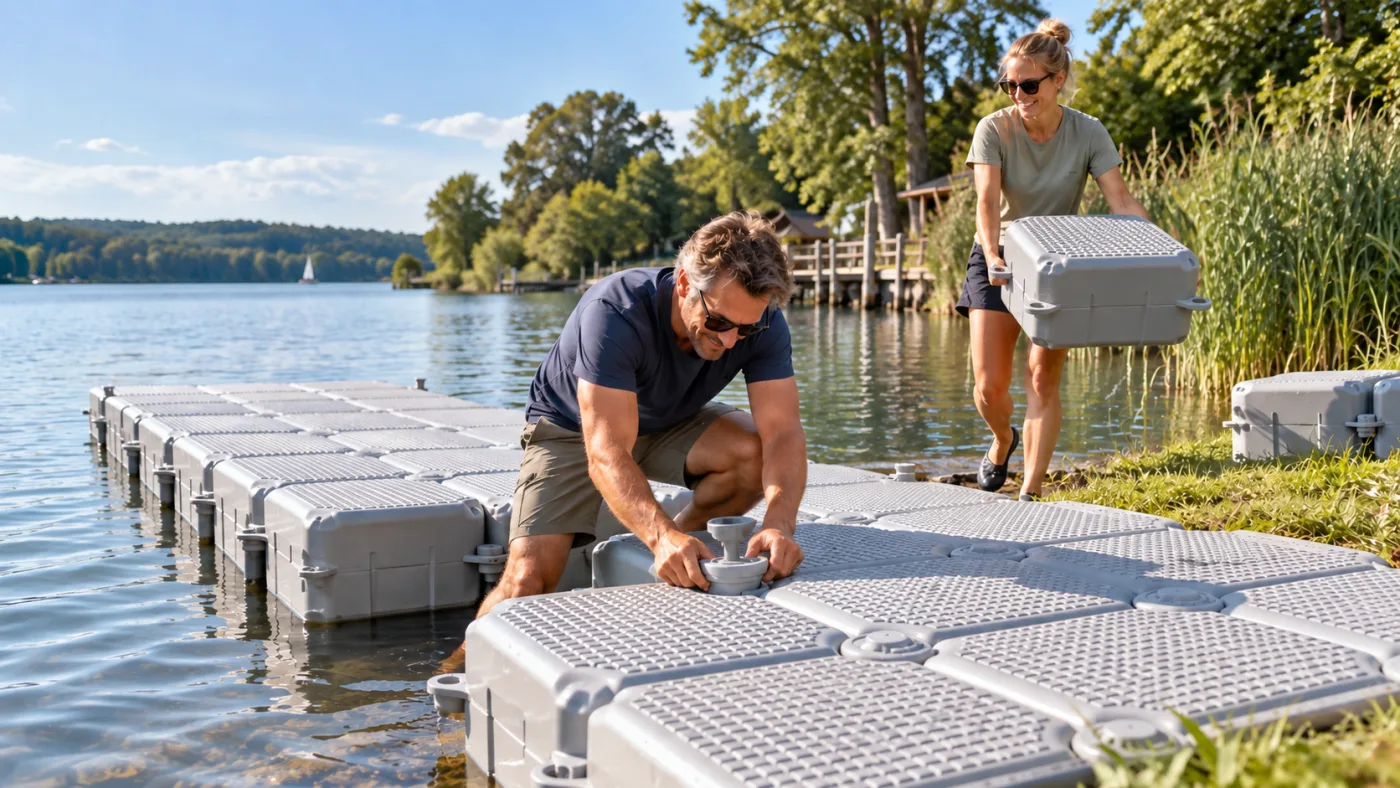
A floating pontoon made of modular floats consists of just four parts, repeated over and over. The float measures 500 × 500 × 400 mm, weighs 6.8 kg and carries around 87 kg. Four of them make one square metre. Each float has a lug at every corner, and where four floats meet, a coupling pin holds the lugs together.
Along the outer edges, where only two lugs overlap, you join the floats with a bolt and nut set. The spacer ring makes up for the missing lug height there, so everything sits flush. Add a rubber mallet (€13.50) and a pin spanner (€39.75), which locks each pin with a quarter turn. That is all you need: no boards, no substructure, no concrete. To climb out of the water there is a stainless steel swim ladder that floats with the jetty.
What does a self-built floating pontoon cost?
A floating pontoon made of HDPE floats costs around €250 net per square metre, fully connected. The price depends almost entirely on the number of floats: one float costs €49.50 net and makes up a good three quarters of the total. Pins, bolts and rings add roughly a fifth.
Three typical jetty sizes, calculated with the same formulas as our configurator:
- 1.5 × 4 m (short bathing jetty): 24 floats, €1,491.50 net, carries around 2.1 t
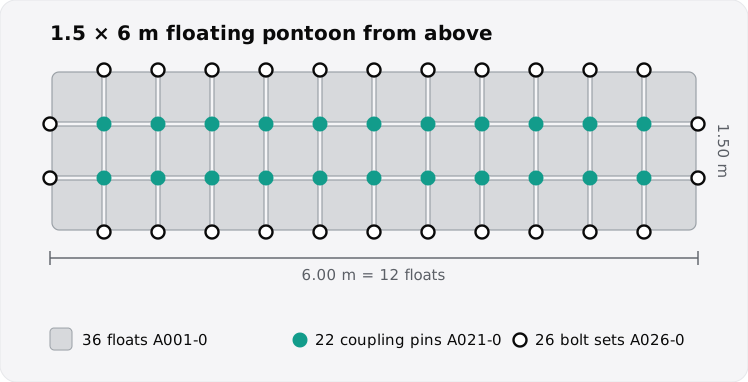
- 1.5 × 6 m (jetty for a small boat): 36 floats, €2,239.50 net, carries around 3.1 t
- 2 × 8 m (wide jetty with room to sit): 64 floats, €3,931.50 net, carries around 5.6 t
You buy the tools once, however large the jetty gets. All prices exclude VAT and freight. We calculate freight individually for your location and include it in your quote. Prices for more sizes, accessories and a complete example are in our guide What does a floating pontoon cost?
Example: parts list for a 1.5 × 6 m floating pontoon
| Part | Part no. | Qty | Unit price | Total |
|---|---|---|---|---|
| Single float H40, grey | A001-0 | 36 | €49.50 | €1,782.00 |
| Short coupling pin | A021-0 | 22 | €9.00 | €198.00 |
| Short bolt and nut set | A026-0 | 26 | €8.50 | €221.00 |
| Spacer ring, thick | A029-0 | 11 | €3.50 | €38.50 |
| Materials total | €2,239.50 | |||
| Rubber mallet (one-off) | A031-3 | 1 | €13.50 | €13.50 |
| Pin spanner (one-off) | A032-7 | 1 | €39.75 | €39.75 |
| Total net | €2,292.75 |
All prices net, excluding VAT and freight (calculated individually).
How wide should a floating pontoon be?
A floating pontoon should be at least three floats wide, which is 1.5 m. Any narrower and it feels unsteady underfoot, because it lacks support to the sides. At 1.5 m nothing tips, even with two people standing side by side at the edge. For a jetty where you also want to sit, have a barbecue or lay down your SUP, 2 m is more comfortable.
How deep does the water need to be for a floating pontoon?
We recommend at least twice the height of the float, so 80 cm of water for the 40 cm floats. Under full load a float sinks in by around 35 cm. That leaves enough margin for the jetty to float freely even with several people on it.
How do you assemble a floating pontoon yourself?
Two people assemble a 1.5 × 6 m jetty in less than an hour. Here is how:
- Plan the size. Set length and width in the configurator; it works out your parts list down to the last pin. Plan in half metres, because that is the grid of the floats.
- Find a level spot on the bank. A lawn, sand or a flat beach will do. Only on land do the lugs lie flat on top of each other, and if a pin is stubborn you can step it in with your body weight.
- Join the floats row by row. Lay four floats so that their corner lugs overlap, insert the coupling pin and tap it flush with the rubber mallet. A quarter turn with the pin spanner locks it.
- Close the outer edges. Where only two lugs overlap, fit a bolt and nut set with a spacer ring.
- Push the jetty into the water. Only build as much on land as you can still push or carry. With 36 floats that is around 245 kg, so build a long jetty in two or three sections and connect the rest in the water.
- Anchor it. How to do that is explained in the next section.
How do you fix a floating pontoon to the bank?
On the bank you connect the jetty with at least two L-shaped jetty brackets (€135 each); in the water piles or anchors hold it. In up to three metres of water with a firm bottom, you drive in a pile and fit a pile guide (from €175) to the jetty, so it slides up and down with the water level. In deeper water or on a soft bottom, use a 40 kg ground anchor (€265) with anchor bracket and chain.
The manufacturer recommends two ground anchors or four piles per jetty, with a chain per anchor as long as the water depth plus 2 m. Which route suits you depends on how much your water level varies. On a flooded gravel pit with a few centimetres of variation, the ground anchors are enough. On a river or a reservoir, the pile guide is the safe choice. More in our guide Anchoring a floating jetty.
Do you need permission for a floating pontoon?
That depends on where it goes. Depending on the country and the body of water, a floating pontoon may need a permit, so check with the responsible authority before you order. This is not legal advice. For the UK, the rules are set out in our guide Do I need permission for a pontoon in the UK?
Why floats instead of barrels and timber?
A jetty made of barrels and boards is cheaper to buy, but not to maintain. Timber needs regular painting, steel drums rust, and loose barrels shift under the platform. HDPE floats absorb no water, are UV-stable and frost-resistant, and need no care. You can extend or widen the jetty at any time, or bring it ashore for the winter. We give a five-year warranty.
Prices as per our price list of 01/10/2026. Prices may change. Before you buy, get a current, binding quote via the configurator or an enquiry.
Plan your jetty in five minutes
Enter length and width in the configurator and you will see straight away how many floats, pins and bolts your jetty needs and what it costs. Send us the parts list with one click and we will come back with a quote including freight. We have built pontoons ourselves and are happy to advise, including on custom shapes.