
Guide
Do I need permission for a pontoon in the UK?
Almost always, yes, and often from more than one body. Which permission you need depends on the part of the UK and on the water: in England a jetty on a main river usually needs a flood risk activity permit from the Environment Agency, on the Thames an accommodation licence and at the coast a marine licence. Scotland, Wales and Northern Ireland have their own authorities. The exemption for small platforms on English rivers does not cover pontoons; at the coast, by contrast, small pontoons can be exempt.
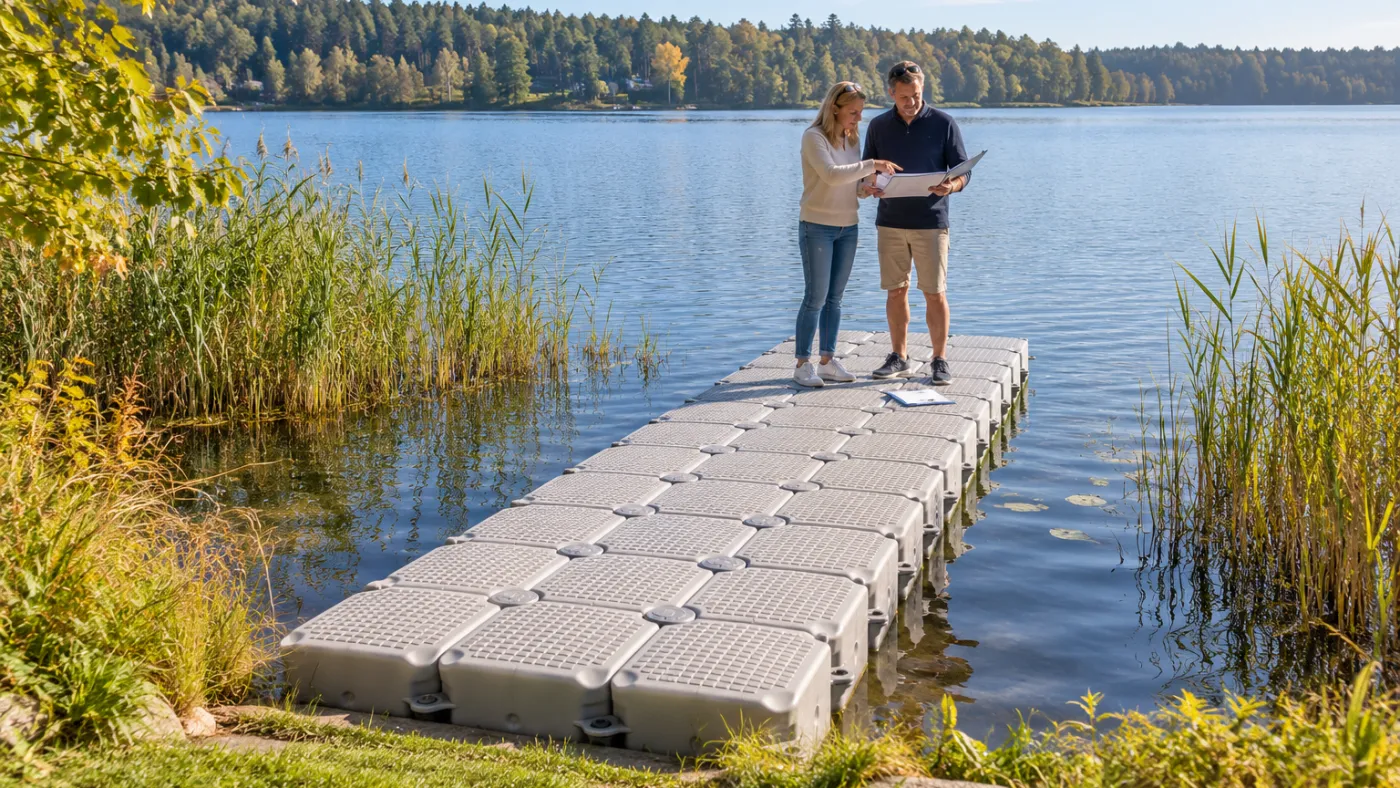
Can I just put a pontoon in the water?
No. In the UK a jetty or pontoon counts as a structure in or over the water, and putting one in is a regulated activity almost everywhere. On English and Welsh main rivers, for example, the rules cover any structure “in, over or under a main river”, whether temporary or permanent. Even where you need no permit, you usually have to register your structure or notify the authority first.
The permit is one thing, the land is another. If you do not own the bank or the bed, you also need the owner’s consent. The Environment Agency says so explicitly for its exemption for small platforms, and on canals the Canal & River Trust is often the landowner as well as the navigation authority.
Who is responsible where?
That depends on the part of the UK and on the kind of water. The main bodies are:
- England: the Environment Agency for main rivers and the Thames, the Lead Local Flood Authority or Internal Drainage Board for smaller watercourses, the Marine Management Organisation (MMO) at the coast.
- Canals in England and Wales: the Canal & River Trust for waterways it owns or manages.
- Scotland: the Scottish Environment Protection Agency (SEPA) inland, the Marine Directorate of the Scottish Government at the coast, Scottish Canals on the canals.
- Wales: Natural Resources Wales (NRW) for main rivers and the coast, the local authority for smaller watercourses.
- Northern Ireland: DfI Rivers for rivers and streams, DAERA at the coast.
- Everywhere: possibly the local planning authority as well, more on that below.
Permission for a jetty or pontoon: the UK at a glance
| Part of the UK and water | What applies | Responsible |
|---|---|---|
| England, main river | Flood risk activity permit; a single small fixed access platform is exempt after free registration, pontoons are not | Environment Agency |
| England, ordinary watercourse | Consent if the jetty obstructs the flow (Land Drainage Act 1991, s. 23) | Lead Local Flood Authority or Internal Drainage Board |
| England, River Thames | Accommodation licence for every jetty or pontoon, private ones too; environmental permit for new or altered structures | Environment Agency |
| England and Wales, Canal & River Trust waterways | Consent under the Trust’s Code of Practice, then an agreement or licence | Canal & River Trust |
| England and Wales, coast | Marine licence; pontoon with up to 30 m² of deck exempt with harbour authority consent and prior notice | MMO (England), NRW (Wales), harbour authority |
| Scotland, lochs and rivers | Loch: registration up to 50 m², permit above; river: General Binding Rule up to 10 % of bed width and 10 m length | SEPA |
| Scotland, coast | Marine licence; pontoons are not covered by the exemption for moorings | Marine Directorate, Scottish Government |
| Scotland, canals | Consent from Scottish Canals and Scheduled Monument Consent | Scottish Canals, Historic Environment Scotland |
| Wales, rivers | Main river: flood risk activity permit, access platforms can be registered as exempt; smaller watercourses: ordinary watercourse consent | Natural Resources Wales, local authority |
| Northern Ireland | Rivers: Schedule 6 consent if the free flow is affected; coast: marine licence, pontoons not exempt; planning and waterways: ask locally | DfI Rivers, DAERA |
Legal position as of October 2026, not legal advice. Planning permission may be needed in addition everywhere; the local planning authority decides.
What applies on rivers and canals in England?
On a main river you will usually need a flood risk activity permit from the Environment Agency. The guidance does not name jetties, but it covers erecting any temporary or permanent structure in, over or under a main river. The Agency normally decides within two months, and if you ask whether you need a permit at all, it aims to reply within 10 working days.
There is one exemption: you can build a single small access platform, for example for fishing, after registering it free of charge before you start. The conditions are tight. The platform may project no more than 1.2 m into or over the river and take up no more than 2 m of bank, it must stand on piers or piles no more than 300 mm wide, at least 50 m from any other man-made structure and at least 500 m from protected sites such as SSSIs. Pontoons are expressly excluded.
On a smaller watercourse (an ordinary watercourse) you need no Environment Agency permit. Consent from the Lead Local Flood Authority or the Internal Drainage Board may still be needed if your jetty could obstruct the flow; the Environment Agency names creating or changing a mooring as work you should check first.
On the Thames, every jetty, pontoon or landing stage needs an accommodation licence from the Environment Agency, whether for private, shared or commercial use, plus an environmental permit for new or altered structures. There is an administration fee and an annual charge, and the licence is not transferable: if you sell the property, the new owner must apply for their own.
Where your jetty affects property owned or managed by the Canal & River Trust, you need the Trust’s consent under its Code of Practice, in two stages: a technical and environmental review, then an agreement or licence for the use. The application fee is £400 plus VAT, at the Trust’s discretion £150 plus VAT for private residential properties, and the Trust asks to be contacted around three months before work begins.
What applies in Scotland, Wales and Northern Ireland?
In Scotland, jetties and platforms in lochs and rivers are water activities regulated by SEPA. On a loch, structures with a total area of up to 50 m² need a registration with standard conditions; the application fee is £198.55, plus annual charges. Larger structures need a permit. On a river, a structure taking up no more than 10 % of the bed width and 10 m of the watercourse is usually covered by a General Binding Rule, with no application, as long as you keep to its conditions. On the Scottish canals, which are scheduled ancient monuments, you also need Scheduled Monument Consent from Historic Environment Scotland; Scottish Canals asks householders to get in touch at the start of planning.
In Wales, Natural Resources Wales issues the flood risk activity permit for structures on a main river. Access platforms can be registered as exempt free of charge if they meet the conditions of NRW’s guidance; whether a floating pontoon can qualify, we have not been able to check. On a smaller watercourse, contact your local authority for ordinary watercourse consent.
In Northern Ireland, DfI Rivers must approve works that will affect the free flow of a watercourse (Schedule 6 consent). Whether a jetty falls under this depends on the individual case, so ask before you plan. For planning and for the inland waterways we found no official statement; ask DfI Rivers and your council what applies to your site.
What applies at the coast?
At the coast and in tidal waters you generally need a marine licence to construct works in or over the sea or on the sea bed, unless an exemption applies. The licence comes from the MMO in England, from NRW in Wales, from the Marine Directorate in Scotland and from DAERA in Northern Ireland.
In England and Wales a pontoon put in with the consent of the harbour authority needs no marine licence, provided you notify the licensing authority before you start. The exemption does not apply to pontoons with a deck area of more than 30 m². In Wales the pontoon must also lie within harbour or port limits, notice must reach NRW and the Welsh Government 15 days in advance, and the exemption excludes piling and buildings on the pontoon. In Scotland and Northern Ireland the exemption for moorings expressly excludes pontoons; a separate pontoon exemption like the English one we did not find there.
Does it make a difference whether the jetty floats?
Sometimes, but not always in your favour. A pontoon is not exempt just because it floats and can be removed again. You hear that assumption a lot; the official sources do not support it. On main rivers in England and Wales the rules cover any structure, temporary or permanent.
On English main rivers, floating actually counts against you: the exemption for a single small platform covers fixed platforms only, and the Environment Agency states plainly that you cannot moor pontoons under it. On the Thames, jetties, pontoons and landing stages all need the same licence. At the coast it is the other way round: in England and Wales pontoons up to 30 m² of deck have their own exemption, fixed jetties do not. How the two designs differ otherwise is explained in our guide Piles or floats?
Do I need planning permission for a pontoon?
You may. Planning permission is a separate question from the water permits above, and the local planning authority decides whether you need it. The Environment Agency points out for both its platform exemption and the Thames licence that you may also need planning permission. The Canal & River Trust says that planning permission may be required for building staging at an end-of-garden mooring; it recommends getting its agreement in principle first and holding a pre-application consultation with the council.
We have not checked the national planning rules for small structures in detail, so we cannot tell you when a jetty is free of planning permission. Ask your local planning authority before you order.
How do you go about it?
In this order you save yourself detours:
- Identify your water. Find out whether your site is on a main river, a smaller watercourse, the Thames, a canal or tidal water, and who owns the bank and the bed.
- Contact the authority. Use the table above to find the right body. Describe your plans briefly: location, length, width, floating jetty. Ask whether you need a permit, a registration or a notice and what documents they want. In England, the Environment Agency will tell you within 10 working days whether a permit is needed.
- Plan your jetty. Set length and width in the configurator and request a quote. It lists dimensions, parts and price for your application.
- Get the landowner’s consent. If you do not own the bank or the bed, get the owner’s agreement in writing. On canals, contact the navigation authority early.
- Apply, register or notify. With the water authority, and at the coast with the harbour authority as well. Check with the local planning authority whether you also need planning permission.
- Build only once you have the go-ahead. That means once your permit, licence or registration is in place, or the notice period has passed.
Where does this information come from?
In October 2026 we evaluated official guidance and legislation for all four parts of the UK: from the Environment Agency, the Marine Management Organisation, SEPA, the Scottish Government, Natural Resources Wales, the Department for Infrastructure and DAERA in Northern Ireland, the Canal & River Trust and Scottish Canals, together with the Environmental Permitting (England and Wales) Regulations 2016, the Land Drainage Act 1991, the Marine and Coastal Access Act 2009, the Marine (Scotland) Act 2010, the Environmental Authorisations (Scotland) Regulations 2018 and the Marine Licensing (Exempted Activities) Orders for England, Wales, Scotland and Northern Ireland. Every statement in this guide is based on an official source.
Some things we could not verify: national planning rules, the detailed conditions of NRW’s platform exemption, the rules of individual harbour and navigation authorities, and planning and inland waterways in Northern Ireland. Where that matters, we say so above.
We build jetties, we are not lawyers. This guide reflects the legal position as of October 2026 and is not legal advice. Only the responsible authority can give you a binding answer.
Plan your jetty
Once you know what your authority needs, plan your jetty in the configurator and request a quote. You can use the dimensions, parts list and price straight away for your application. Questions about the jetty itself, about width, anchoring or water depth, we are happy to answer.