
Guide
Garden pond jetty: can it float?
Yes, if your pond is at least 50 cm deep at that spot. A floating pond jetty made of HDPE floats needs no piles and no substructure, and the pond liner stays intact. A 1.5 × 2 m jetty consists of 12 floats and costs €743.50 net in materials. It goes together in an afternoon.
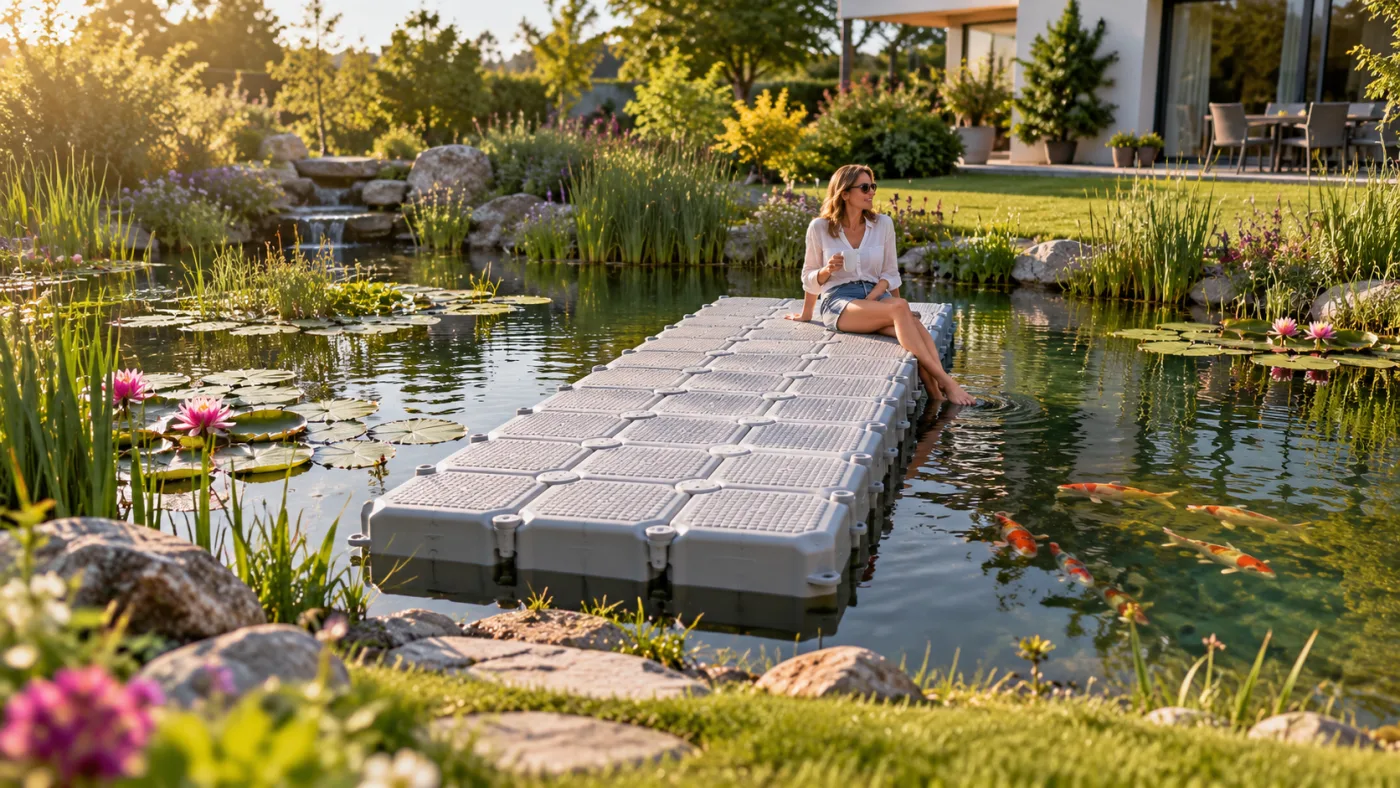
Why a floating jetty protects the pond liner
A classic pond jetty stands on piles or pad foundations. In a garden pond that means either the piles go through the liner, or you have to plan the foundations when building the pond and laboriously seal the liner around every post. Each of those spots is a potential leak later on.
A floating jetty needs none of that. The floats are the substructure themselves: they carry the jetty and form the walking surface at the same time. You put it on the water, fix it to the bank, and that is it. The liner stays as it is, and it works for a pond that has been there for years, too.
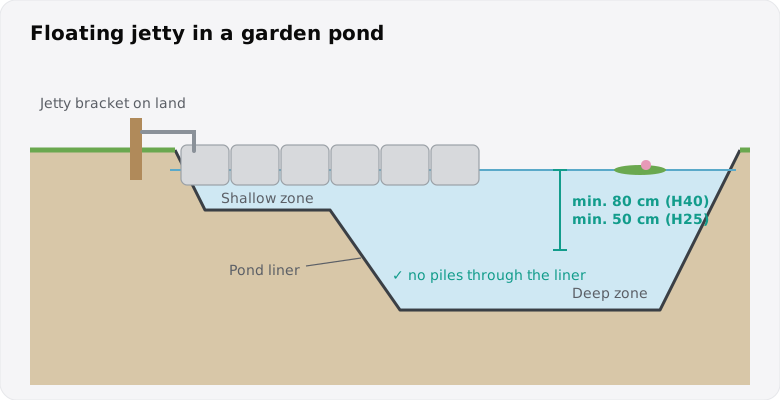
How deep does a pond need to be for a floating jetty?
For the standard 40 cm floats we recommend at least 80 cm of water, for the low 25 cm floats at least 50 cm. That is twice the float height in each case. It leaves enough water under the jetty for it to float freely even with two or three people on it.
Many garden ponds have a deep zone of 80 to 150 cm with shallower planting shelves in front. Plan the jetty so its outer part sits over the deep spot. If the bank end touches down on the shallow shelf, that does the floats no harm. If it rests on pond liner there, put a piece of protective underlay beneath it, as you would under stones.
- H40, 40 cm high: from 80 cm of water, €49.50 per float, carries around 87 kg, also available in black.
- H25, 25 cm high: from 50 cm of water, €46.50 per float, carries less but enough for a pond jetty to sit on. In grey, blue and orange.
How big should a pond jetty be?
A floating jetty should be at least three floats wide, which is 1.5 m. Any narrower and it feels unsteady underfoot. Length goes in half metres. Three sizes that suit typical garden ponds:
- 1.5 × 2 m: 12 floats, €743.50 net. Room for two chairs by the water.
- 1.5 × 3 m: 18 floats, €1,117.50 net. Reaches further into the pond, good for feeding the fish.
- 2 × 2 m: 16 floats, €985.50 net. A small square platform with room for a table too.
All prices net with H40 floats and the complete connecting hardware, calculated with the same formulas as our configurator. How assembly works is explained in our guide Building a floating pontoon.
Example: parts list for a 1.5 × 2 m pond jetty
| Part | Part no. | Qty | Unit price | Total |
|---|---|---|---|---|
| Single float H40, grey | A001-0 | 12 | €49.50 | €594.00 |
| Short coupling pin | A021-0 | 6 | €9.00 | €54.00 |
| Short bolt and nut set | A026-0 | 10 | €8.50 | €85.00 |
| Spacer ring, thick | A029-0 | 3 | €3.50 | €10.50 |
| Materials total | €743.50 | |||
| Rubber mallet (one-off) | A031-3 | 1 | €13.50 | €13.50 |
| Pin spanner (one-off) | A032-7 | 1 | €39.75 | €39.75 |
| Total net | €796.75 |
All prices net, excluding VAT and freight. We calculate freight individually for your location.
How is the pond jetty fixed to the bank?
A garden pond has no waves and no current, so you do not need heavy anchoring in the water. Fixing the jetty to the bank is enough. The neatest way is two L-shaped stainless steel jetty brackets (€135 each), which you fix on land to posts or pad foundations, outside the pond liner. Simpler but less elegant: two ropes to pegs in the lawn.
For a smooth step from lawn to jetty there is a bevelled float (€47.50). It forms the edge towards the bank, so there is no step to trip over.
Which colour suits a garden pond?
Grey is standard and goes equally well with natural stone, gravel and timber. If you want the jetty to be as unobtrusive as possible, choose black: it almost disappears visually in dark pond water. Black is available in the 40 cm floats. Blue and orange are more for swim platforms than for the garden.
Does a jetty disturb fish and plants?
No, if anything the opposite. A jetty provides shade, and fish like to stay in the shade, especially on hot days. The pond-building rule of thumb still applies: jetty, water lilies and floating plants together should cover no more than about a third of the water surface, so enough light reaches the submerged plants.
The floats are made of HDPE, a plastic that absorbs no water and needs neither painting nor impregnating. So no wood preservatives or varnishes get into the pond water.
Can the jetty stay in the pond over winter?
Yes. HDPE is frost-resistant and absorbs no water, so ice does not damage the floats. On a garden pond the ice lies still, unlike on a river with drifting ice. So you can leave the jetty in the pond all year round.
Do I need a permit for a jetty in a garden pond?
Usually not for a pond in your own garden, as permit requirements for floating structures generally concern lakes, rivers and other public waters. Rules vary by country, though: if your property borders a natural body of water or the pond is connected to one, check with your local authority first. This is not legal advice. For the UK, the rules are set out in our guide Do I need permission for a pontoon in the UK?
Prices as per our price list of 01/10/2026. Prices may change. Before you buy, get a current, binding quote via the configurator or an enquiry.
Plan your pond jetty
Measure the deep spot in your pond and enter length and width in the configurator. You will see straight away how many floats you need and what the jetty costs. Mention in your enquiry that it is for a garden pond, and we will advise you on float height, colour and fixing.