
Guide
Dock on barrels or on floats: which lasts longer?
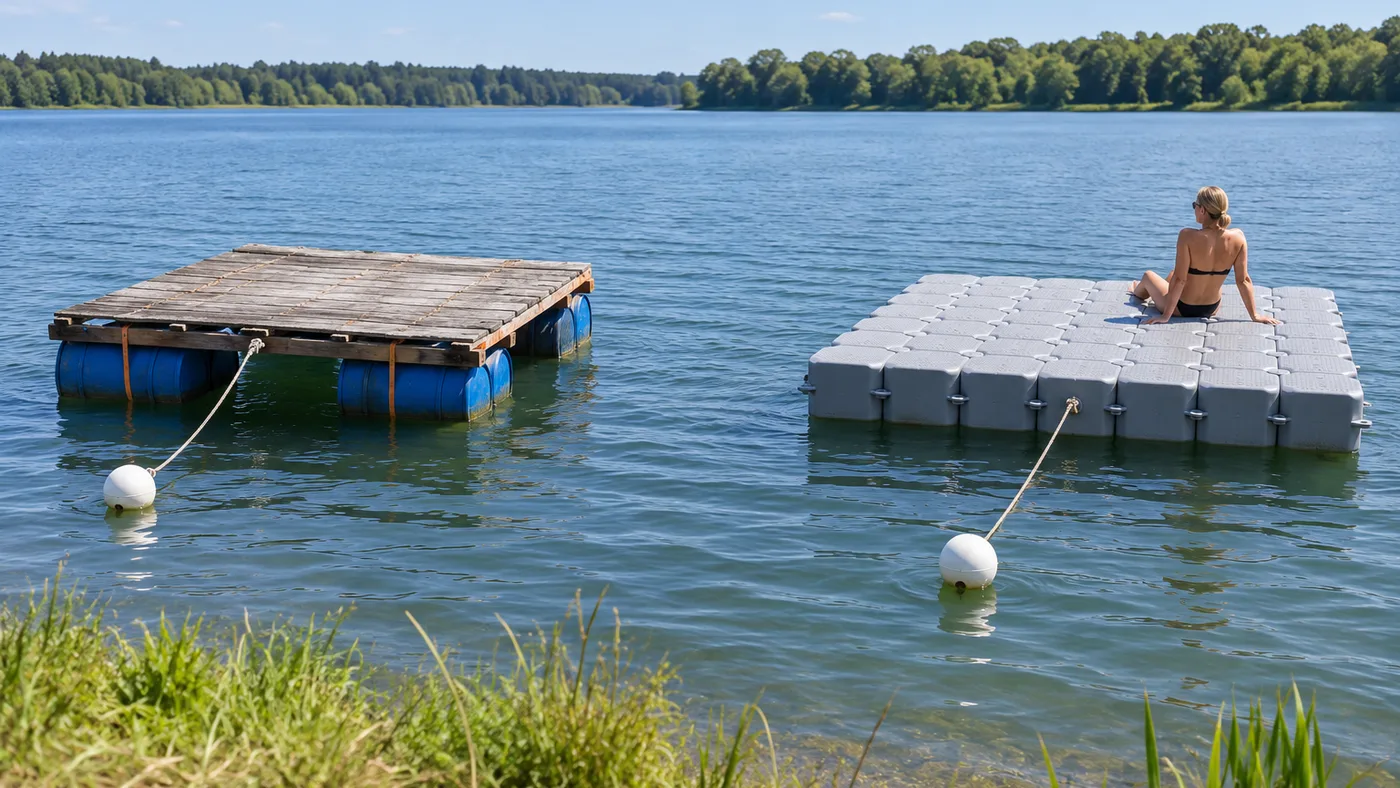
A dock made of floats lasts much longer than a barrel raft. Barrels are built for storage and transport, not for years in the water: their walls are thin, steel drums rust, and the timber frame on top needs looking after. For a raft that only has to last one summer, barrels will do. For a jetty that is meant to stay in place for many years, use floats.
How much does a barrel carry compared with a float?
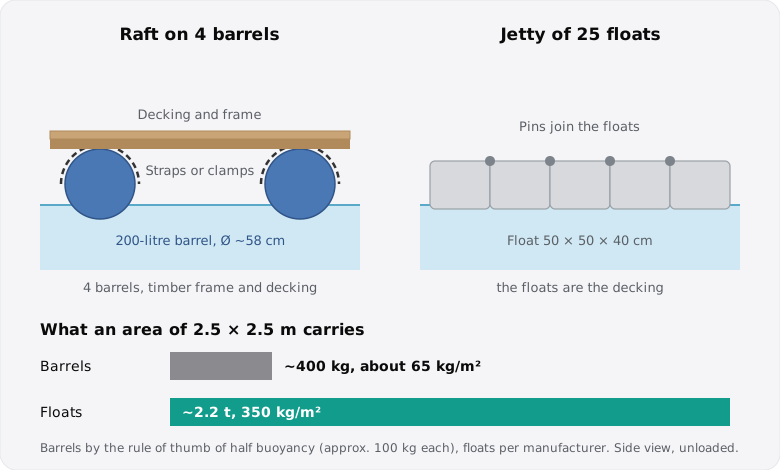
Fully submerged, a 200-litre barrel displaces 200 kg of water; minus its own weight, the buoyancy is a little less. But you do not want it to go right under, or the decking ends up in the water. That is why raft builders work to a rule of thumb of about half, so roughly 100 kg per barrel.
The barrels sit spaced out under a timber frame. A typical 2.5 × 2.5 m raft stands on four barrels and so carries around 400 kg, which is about 65 kg per square metre.
Our floats, on the other hand, sit tight against each other and form the surface themselves. Each float measures 50 × 50 × 40 cm, four of them make one square metre, and that square metre carries 350 kg according to the manufacturer. The same 2.5 × 2.5 m area made of 25 floats therefore carries around 2.2 t. Even at full load a float sinks only about 35 cm into the water, so the jetty stays above the surface.
Why do barrels not last as long in the water?
Because they are made for something else. A barrel is meant for storage and transport, and its wall is much thinner. According to the manufacturer, our floats have a wall of about 5 to 8 mm and a base of 6 to 10 mm, because they lie in the water all year, take the waves and are walked on.
On top of that come the weak points around the barrel:
- Rust: Steel drums rust through in the water, often within a few years. For a jetty, only plastic barrels are an option.
- Lids and bung holes: Water seeps in through leaking closures, and the barrel loses buoyancy without you noticing. The jetty then lists to one side.
- Timber frame and fixings: The barrels are held to the frame with ropes, straps or clamps. Ropes chafe through, screws rust, and timber that is constantly wet has to be painted and eventually replaced.
A float is a sealed hollow body made of HDPE, a plastic that does not absorb water, does not rot and never needs painting. Pressure equalisation stops it from swelling in the heat. It needs no frame, because the floats are connected directly to each other. We give a five-year warranty on the material.
Barrel raft or floating pontoon: compared
| Criterion | Raft on barrels | Jetty made of floats |
|---|---|---|
| Load capacity | around 65 kg/m² (4 barrels under 2.5 × 2.5 m) | 350 kg/m² |
| Wall thickness | thin, built for transport | wall 5–8 mm, base 6–10 mm |
| Substructure | timber frame, decking, ropes or clamps | none, the floats are the decking |
| Maintenance | paint the timber, check ropes and closures | none |
| In the water | tips when there is weight at the edge | steady from 1.5 m wide |
| Winter | better ashore | can stay in the water |
| Extending, rearranging | build a new one | add or remove floats at any time |
| Warranty | none | 5 years on the material |
Barrel raft load capacity based on the rule of thumb of half buoyancy per 200-litre barrel. Float load capacity according to the manufacturer.
Does a barrel raft sit steady in the water?
Less so than a floating pontoon. Barrels are round and want to roll, so the frame has to hold them firmly. And the whole load rests on just a few barrels: if someone stands at the edge, the barrel underneath sinks noticeably deeper and the raft tips to that side.
On a jetty made of floats, every float under the surface takes its share, so the weight is spread over many points. From 1.5 m wide it lies steady, even with several people standing at the edge. A little movement in waves remains on any floating jetty.
What should I watch out for with used barrels?
Above all, what they held before. Cheap used barrels often contained oil, cleaning agents, chemicals or food additives. Whatever is left inside will end up in the water sooner or later. So only use barrels whose previous contents are known and harmless, and clean them thoroughly.
The material makes no difference when it comes to permission: a jetty on barrels is treated just like one made of floats. Whether you need permission depends on the country and the body of water, so check with the responsible authority. What applies in the UK is covered in our guide Do I need permission for a pontoon in the UK? This is not legal advice.
What does a floating pontoon made of floats cost in comparison?
A barrel raft is cheaper in materials, especially with used barrels. But then you add timber for the frame and decking, screws, ropes or clamps, and the time spent building and maintaining it. And after a few years you start all over again.
With floats, the substructure is the decking at the same time, so there is no timber and no frame. Two examples, each excl. VAT and including all pins, bolts and rings:
- Platform 2.5 × 2.5 m (25 floats): €1,531.50
- Jetty 1.5 × 6 m (36 floats): €2,239.50
The configurator works out the price for your size straight away. Everything about assembly and the parts list is in our guide Building a floating pontoon yourself.
When is a barrel raft good enough?
When it is only meant for a short time: a swimming raft for one summer, a holiday project with the children, or a trial to see whether a jetty suits the spot at all. In that case: plastic barrels only, cleaned thoroughly, closures watertight, held firmly to the frame with straps or clamps, and back on land in autumn.
If the jetty is to stay for many years, remain in the water over winter or take a boat, a floating pontoon is the better choice. It can stay in the water through frost; more on this in our guide Can a floating pontoon stay in the water over winter? And you can extend it, rearrange it or rebuild it somewhere else at any time.
Prices as per our price list of 01/10/2026. Prices may change. Before you buy, get a current, binding quote via the configurator or an enquiry.
Plan your jetty
Enter the length and width in the configurator and tell us in your enquiry what the jetty is for and how deep the water is. You will then get the complete parts list with prices, including suitable anchoring.